
- Home
- Snowflake vs Traditional Data Warehouses: Why Businesses Are Making the Switch
Snowflake vs Traditional Data Warehouses: Why Businesses Are Making the Switch
- admin
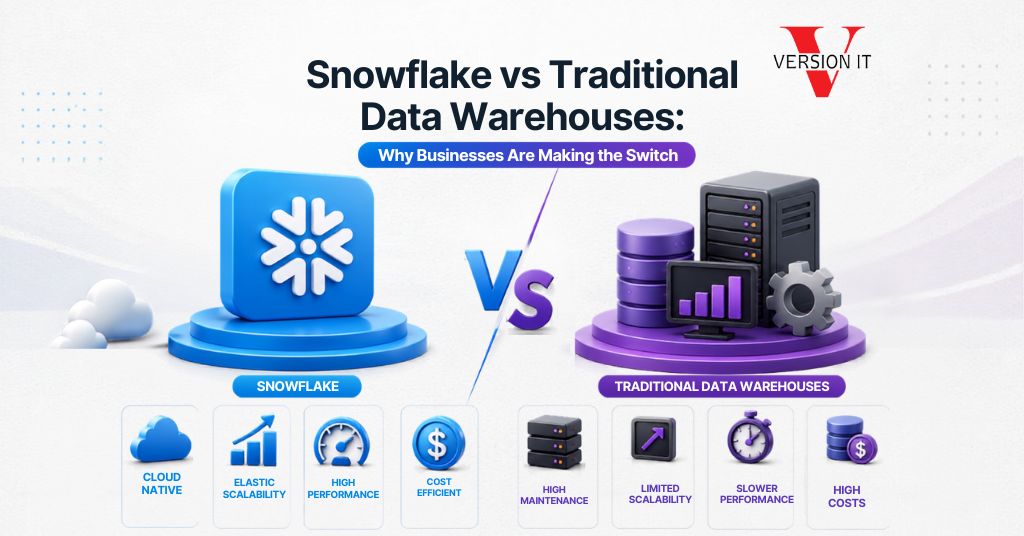
The contemporary businesses produce colossal amounts of data on a daily basis. Since the interaction with customers and sales transactions are only a part of the data that should be stored, processed and analyzed efficiently by organizations to enable them to stay competitive against the competitors. Traditional data warehouses have been the basis of enterprise analytics over the decades. Nevertheless, the fast-evolving cloud computing and big data has altered how the organizations handle information.
Snowflake has become one of the most powerful solutions that has revolutionized the use of cloud-based data platforms by overcoming most of the shortcomings of traditional data warehouses. Companies in all sectors are moving their data ecosystems to Snowflake in order to enhance their performance, scalability, and operational performance.
With the continued growth in demand of Snowflake expertise, professionals are enrolling in Snowflake Training In Bangalore to acquire the necessary skills to work in the modern cloud data environments. Figuring out the reasons behind this move by businesses can assist organizations and future data professionals to be on top of a fast-changing market.
The Limitations of Traditional Data Warehouses in Today’s Data-Driven World
The traditional data warehouses were created in another time of business intelligence. Although they served organizations well over the years, they may not be able to meet the modern needs of data.
Most of the legacy warehouse systems are dependent on on-premises systems. This poses difficulties like:
- High hardware costs
- Complex maintenance requirements
- Limited scalability
- Lengthy deployment cycles
- Bottlenecks in performance under peak workloads.
- Challenging recovery of disasters.
With the volumes of data constantly increasing exponentially, organizations are unable to effectively expand the traditional infrastructure. Scaling typically involves the need to buy new hardware, upgrade storage systems and commit a lot of time and resources.
There can also be issues with traditional warehouses when more than teams require access to data at the same time. Business users, data scientists, analysts, and data engineers tend to be competing resources in computing and thus lead to reduced productivity and slower query processing.
The restrictions have prompted organizations to find cloud-native solutions that can better support today analytics workloads.
How is the cloud-native architecture of Snowflake transforming the data management?
One of Snowflake’s biggest advantages is its cloud-native architecture. It has an architecture that isolates three critical components:
- Storage: Information is kept in a central place on highly scalable cloud infrastructure.
- Compute: Workloads are processed by virtual warehouses separately.
- Cloud Services: Metadata management, optimization, authentication and governance are independent.
This segregation presents great benefits.
Storage and computing resources can be increased separately on a business needs basis. In case a company needs to get more storage, it can scale without impacting compute performance. Likewise, dynamically scaling of computing resources without raising storage costs is possible.
Such flexibility enables the businesses to not over-provision infrastructure and pay may turn out to be idle.
When professionals undertake a Snowflake Course In Bangalore, they usually get to know how this architecture can be utilized by organizations to handle the large datasets without compromising performance and cost-effectiveness.
How salability and performance address the needs of a modern business?
Conventional warehouses have a high level of planning and then scaling infrastructure. Companies have to make predictions about the future, buy hardware and install updates, which can take weeks or months.
Snowflake eradicates such challenges by enabling an unlimited scaling.
This enables data teams to be able to extract insights as opposed to infrastructure management.
Companies that handle seasonal spikes, high workload analytics or real-time reporting needs are especially likely to take advantage of the dynamic scaling capabilities of Snowflake.
These benefits are practical and can be illustrated by real-life projects in a Snowflake Online Course In Bangalore, which can assist learners in gaining the knowledge of how enterprises attain high-performance analytics on a large-scale level.
Cost Efficiency and Ease of administration lead adoption
One of the primary concerns of organizations that run large-scale data platforms is cost management.
The traditional warehouses normally entail massive initial investments, which include:
- Hardware procurement
- Licensing fees
- Data center infrastructure
- Maintenance contracts
- Dedicated administration teams
Snowflake uses a consumption-based pricing policy that calculates the cost as per its actual usage.
Organizations pay for:
- Storage consumed
- Computing resources used
- Data transfer activities
This approach provides greater financial flexibility and transparency.
Other administrative benefits are:
- Reduced Infrastructure Management: Organizations do not have to have physical servers.
- Automated Maintenance: Snowflake does software updates and performance tuning automatically.
- Built-In Security: The security features are advanced and make compliance simpler.
- Faster Deployment: Quickly new environments can be developed without protracted procurement.
These efficiencies minimize the complexity in operations and provide teams with the opportunity to concentrate on the strategic business endeavors instead of infrastructure maintenance.
Individuals joining Snowflake Online Training In Bangalore regularly get to work with these features which equip them to handle the implementation situations.
Why Snowflake Skills Are emerging as Crucial to Data Professionals?
The increasing use of Snowflake has generated a high demand of skilled workers who can design, administer and optimize Snowflake environments.
Organizations are busily recruiting:
- Snowflake Developers
- Data Engineers
- Cloud Data Architects
- Data Analysts
- ETL Developers
- BI Professionals
- Data Platform Engineers
Experts in Snowflake are in high demand as they are able to assist companies:
- Upgrade old data platforms.
- Improve analytics performance
- Reduce infrastructure costs
- Foster cloud transformation efforts.
- Facilitate higher data sharing and teamwork.
Exposure to more extensive cloud technologies and current data engineering practices is also experience with Snowflake.
With businesses persisting in their digital transformation investments, mastering Snowflake skills can be a major boost to career opportunities.
Conclusion: Why Snowflake is the Future of Data Warehousing
The move to Snowflake instead of the traditional data warehouses is indicative of a larger change in the way organizations manage data. The modern business environment needs high scale, dynamic and economical platforms that are able to sustain high data volumes and more and more complex analytics workloads.
The cloud-native architecture, the ability to independently scale, the high performance, the ease of administration, and the consumption-based pricing of Snowflake make it a desirable solution to organizations that want to modernize their data ecosystems.
This trend is a good opportunity to data professionals. With the demand of Snowflake expertise increasing across sectors, by joining Snowflake Training In Bangalore at Version IT is valuable opportunity to develop the desired skills to work in some of the most popular jobs in cloud data engineering and analytics.
FAQs
1. What are the benefit of Snowflake compared to classic data warehouses?
Snowflake divides storage and computing capabilities, permitting them to be scaled independently, improved performance, reduced costs and simpler management.
2. Who can attend Snowflake training?
The fresh graduates in need of cloud data careers, data engineers, database administrators, developers, analysts, cloud professionals and others gain a lot.
3. Will Snowflake be a good career choice in 2026?
Yes. With the increasing use of Snowflake by most organisations, there is a huge demand of Snowflake professionals.
4. What skills I’ll gain in a Snowflake course?
Training is provided on Snowflake architecture, SQL, loading of data, optimization of performance, security, data sharing, and integrating cloud.
5. Does online training help me to learn Snowflake?
Yes. Lots of Snowflake Online Training In Bangalore programs provide real-time instructor-based training, projects, and certification training.
Enquiry Form
Recent Posts

How to Learn Python Training from Scratch in 2026: A Step-by-Step Roadmap

What Makes Data Analytics Training in Bangalore Valuable for Students and Freshers?

Snowflake Data Engineer Career Growth in Hyderabad: Skills to Build Next

How Does Workday HCM Training Prepare You for Real-World HR Tasks?