- Home
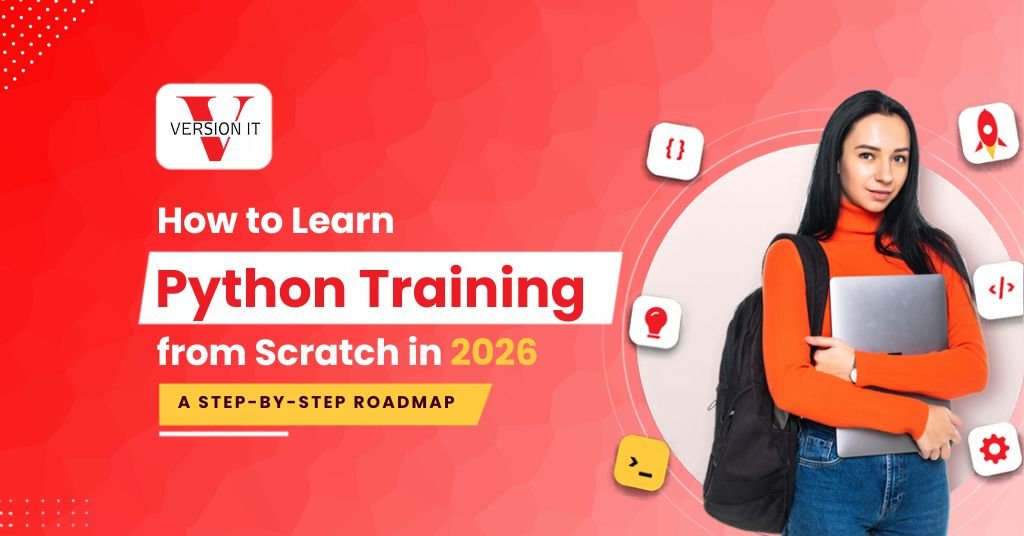
- How to Learn Python Training from Scratch in 2026: A Step-by-Step Roadmap
How to Learn Python Training from Scratch in 2026: A Step-by-Step Roadmap
- admin
Learning to code can feel really hard when you have no experience at all. You might ask yourself which programming language to pick, what things to learn first and how to use what you know to build a job. The nice thing is that Python helps with this because it has easy to understand rules can be used for different tasks and has a lot of different uses.
In 2026 Python remains a tool, for software development data analysis, automation, machine learning and artificial intelligence. Whether you are a student, a graduate, a working professional or someone who wishes to change careers I believe learning Python can open doors. Python can help you move forward in ways.
If someone is searching for Python training in Hyderabad following a learning plan can help them develop their abilities. By doing hands-on tasks working on projects and getting support from a training company, like Version IT a person can go from knowing nothing to being a skilled Python programmer.
Why Should You Learn Python in 2026?
Python is a programming language that’s very easy for new people to learn. The code in Python is clear and simple to read. Other programming languages can have rules, for basic tasks.. With Python new learners can spend more time thinking about solving problems and learning how programming works.
Here are some reasons to consider learning Python in 2026:
Beginner-friendly: Python is suitable for people, with no programming experience.
Machine learning: Python is widely used to develop AI applications. Python is widely used to develop systems. Python is widely used to develop machine learning models.
Web development: Frameworks such, as Django and Flask help developers build websites and build web applications. Web development can be easier when using these frameworks.
Data analysis: Libraries like Pandas and NumPy help, with data processing and analysis.
Automation: I find that Python scripts can automate tasks and boost productivity.
Career flexibility: I see that Python skills are useful for software development, data engineering, testing and AI‑related jobs.
For beginners I think that joining a Python course, in Hyderabad can give a learning path hands‑on assignments and chances to ask questions while learning.
Step 1: Understand the Basics of Programming
I think before you start building apps you should get an idea of how programming works. Programming is the foundation of all apps.
First learn what a programming language is. Then figure out how instructions are run step, by step. Also see how programs are made to solve problems. This helps you get started the way.
Focus, on these concepts:
- Variables and data types
- Numbers and strings and Boolean values
- Input and output operations
- Operators and expressions
- Comments and basic syntax
- Type conversion
Step 2: Learn Python Conditions Loops and Data Structures
After you grasp the basics it is wise to dive into Python Conditions Loops and Data Structures. I have found that Python Conditions Loops and Data Structures let you decide how a program will act.
Conditional statements
I find statements because statements let a program decide what to do. Conditional statements also show how to use if, elif and else to run instructions based on conditions.
Loops
Loops help loops repeat tasks so you do not have to write code times. I find Loops, for learning. Practice using Loops, both for and while Loops, with examples.
Data structures
Python has built-in data structures that help store and organize information.
Lists: hold groups of items making it easy to group things together.
Tuples: Keep ordered groups that stay the same once they are made.
Sets: Keep groups of values.
A dictionary keeps information in pairs. In each pair a dictionary has a key that matches a value. I think a dictionary is a tool. Try to make a student marks calculator, a shopping list app or a number guessing game using the idea.
These basics are important, for anyone taking Python training or attending classroom lessons because they build the base for more complex coding.
Step 3: Learn Functions and Object‑Oriented Programming
After learning conditions and loops focus on writing organized code.
Functions let you group instructions, into blocks. Functions can be defined arguments can be passed values can be. Variable scope can be understood. I find that functions make coding easier and cleaner.
Next explore programming (OOP). OOP is widely used in application development.
Object oriented programming concepts include:
- Classes and objects
- Constructors
- Inheritance
- Encapsulation
- Polymorphism
- Methods and attributes
You do not need to learn every idea away. Begin with examples like making a class for a bank account or making a class for a student record.
If you know functions and OOP it will be simpler to handle programs and frameworks. A structured Python training institute in Hyderabad can assist you in practicing these ideas through step, by step activities and coding tasks.
Step 4: Work on File Handling, Errors, and Modules
Real-world programmers often need to store information handle errors and use code written by developers. File Handling, Exceptions and Modules are essential, for these tasks.
At this stage you should learn how to read and write text files work, with CSV and JSON data handle exceptions and organize code into modules.
For example exception handling helps stop a program from stopping when exception handling comes across errors.
try:
number = int(input(“Please enter a number: “))
print(“Your number is:” number)
except ValueError:
print(“Please enter a valid integer.”)
It is also an idea to learn about Python’s package management tools. In particular you should explore pip. You should also practice using environments to keep project dependencies tidy.
These skills will take you further, than doing exercises. They will also get you ready to build applications that can handle real-world situations.
Step 5: Work with Databases and APIs
I have found that in modern applications Databases and external services are used all the time. By learning these skills you will see how Python fits into development settings. Start by learning SQL basics. First practice creating tables adding records retrieving data and updating information. After that try linking Python applications to Databases such as MySQL or Postgre SQL. You should also understand the basics of APIs and HTTP requests. Using a tool like requests you can get information from an API. Handle the response in Python.
For example you could create a weather application that gets weather details from an API that is available, to everyone.
Using Python, databases and APIs together lets you build projects. These projects show how you solve problems. Employers notice that. You can make something. It proves your skills. Try it out.
Step 6: Explore Python with AI Training in Hyderabad
Artificial intelligence is a reason why many learners are choosing Python in 2026. It is best to learn the basics of Python first. Then should you move into AI and machine learning.
When you feel ready, with programming look into these topics:
NumPy: working with numbers and arrays.
Pandas: cleaning data, changing data and studying data.
Matplotlib is used for drawing charts and showing data in a way.
Scikit-learn is used for making machine learning models.
AI APIs are used for adding AI functions to Python programs.
You can start with projects. Examples include analyzing a dataset building a prediction model or creating a Chabot that uses an AI API. AI projects are a way to learn.
Learners who want Python with AI training in Hyderabad should seek a curriculum that mixes programming fundamentals with hands‑on AI applications. Learners need a learning plan that covers AI usage AI data privacy and the limits of AI‑generated results.
I think AI tools can help you learn. They are useful. They shouldn’t replace your own understanding of the code. Try to solve problems on your first. Then use AI tools to check your work or make it better. This way you learn more. Grow as a coder.
Step 7: Build Real World Python Projects
Projects help you use what you have learned. Projects also show your skills beyond just theory.
Of finishing coding exercises the aim is to build projects that solve everyday problems.
Here are five project ideas that are easy for beginners to try:
- Expense tracker: I track the money that is spent by the group. I sort that money into categories.
- Student management system: I keep all the information about students, in one place I record their grades. I store their results all together.
- Weather application: I get weather information by using an API to get the data.
- Automated report generator: I take data from a spreadsheet. I make summary reports automatically.
- AI‑powered chatbot: I want to build a chatbot application that talks with people using an AI API. The AI‑powered chatbot starts with projects and then slowly adds new features.
When projects face errors, read error messages carefully test solutions, and document what projects learn. Debugging every problem I solve boosts confidence. Debugging builds confidence, in my skills.
Step 8: Follow a 12-Week Python Learning Roadmap
I think that having a plan helps you stay on track and see how far you have come. This plan is good, for people who are just starting out and can spend one to two hours every day.
Timeline | Topics to Learn | Practical Goal |
Weeks 1–2 | Syntax, variables, data types, operators, conditions | I will create basic programs |
Weeks 3–4 | Loops, collections, functions | I will build a calculator or guessing game |
Weeks 5–6 | OOP, modules, exceptions, file handling | I will create a student management program |
Weeks 7–8 | SQL, APIs, Git, virtual environments | I will build a database‑driven application |
Weeks 9–10 | NumPy, Pandas, testing and automation | I will analyse data. Automate a task |
Weeks 11–12 | Project development and interview preparation | I will complete and present a portfolio project |
This roadmap is flexible. Some learners move ahead quickly. Other learners need time to practice concepts.
The goal is not to rush through every topic. It is to build an understanding and use your skills on your own.
Step 9: Choose the Right Python Training Course in Hyderabad
Self learning is an option but a structured training program can help you follow a curriculum, receive feedback and stay accountable.
When you compare a Python course in Hyderabad think about these factors:
Experienced trainers: I think experienced trainers give explanations and show real‑world uses.
Hands‑on practice: I suggest verifying that the course offers coding tasks, assignments and projects.
Updated curriculum: I recommend ensuring that the curriculum includes modern Python habits and useful development tools.
Clearing support: I believe regular feedback helps you overcome challenges faster.
Career preparation: Resume guidance, mock interviews and project discussions are all tools that help you with your job search. I think career preparation is essential, for a job search.
Flexible learning options give you the choice, between attending classes in person or taking classes online. Flexible learning options allow you to pick the method that suits your schedule and the way you prefer to learn.
Version IT can be a place to start for people who want to learn Python training in Hyderabad. Before joining, look at the course syllabus how the practical training is set up when the classes are and what kind of help is available to see if the program fits what you want to achieve.
If you want to learn from a distance Python online training, in Hyderabad could give freedom while letting you study from your home.
Step 10: Prepare for Python Jobs and Interviews
After building a base and finishing a few projects begin getting ready, for Python Jobs and other entry‑level opportunities.
My plan is to practice interview topics that cover data types and lists and dictionaries and loops and functions and OOP and exception handling and basic SQL. I also plan to practice explaining code and discussing the choices I make while building a project.
Create a portfolio that holds two or three projects. In each project give a description of the project’s purpose list the technologies used highlight the features and explain the challenges that were solved.
Depending on your skills and experience Python can open career paths, such, as junior Python developer, automation tester, data analyst, backend developer or entry-level machine learning practitioner.
Conclusion
Learning Python from scratch in 2026 is possible if you follow a plan practice often and use what you learn in situations. Start with the basics of programming then move on to functions and object‑oriented programming. Study. Application programming interfaces. After that explore automation data analysis or artificial intelligence depending on what you like.
I know you do not need to know everything before starting a Python project. What matters to me is building a foundation and improving through consistent practice.
If you are ready to start your programming journeys look into the Python training at Version IT. Check out the topics covered world learning experiences and how the classes are structured to discover a good way to reach your career dreams.
FAQs
1. Can I learn Python from scratch in 2026?
Yes. People who have never written any code before can start learning Python. I think that with practice and a good plan people can create a strong base in just a few months of learning Python.
2. How long does learning Python normally take?
Getting the basics of Python takes four to six weeks if a Python learner studies regularly. After that becoming good at working on projects and building skills for jobs normally takes three to six months or longer. The speed at which a Python learner gains proficiency depends on how time a Python learner can spend and, on what a Python learner already knows.
3. Is Python useful, for AI and machine learning?
I find that Python is widely used in AI and machine learning. The main reason is that Python provides a collection of libraries, frameworks and development tools.
4. Should I choose online Classroom Python training in Hyderabad?
Both choices can be good. Classroom training can give face to face contact while online training can offer more freedom. Pick the method that helps your way of learning and your time plan.
5. Where can I learn Python in Hyderabad?
You might look into Python training providers such, as Version IT. Examine their syllabus, hands‑on projects, trainer support and learning formats before you pick a course.
Enquiry Form
Recent Posts
How to Learn Python Training from Scratch in 2026: A Step-by-Step Roadmap

What Makes Data Analytics Training in Bangalore Valuable for Students and Freshers?

Snowflake Data Engineer Career Growth in Hyderabad: Skills to Build Next

How Does Workday HCM Training Prepare You for Real-World HR Tasks?