- Home
- Python Full Stack Developer Roadmap for Beginners
Python Full Stack Developer Roadmap for Beginners
- admin
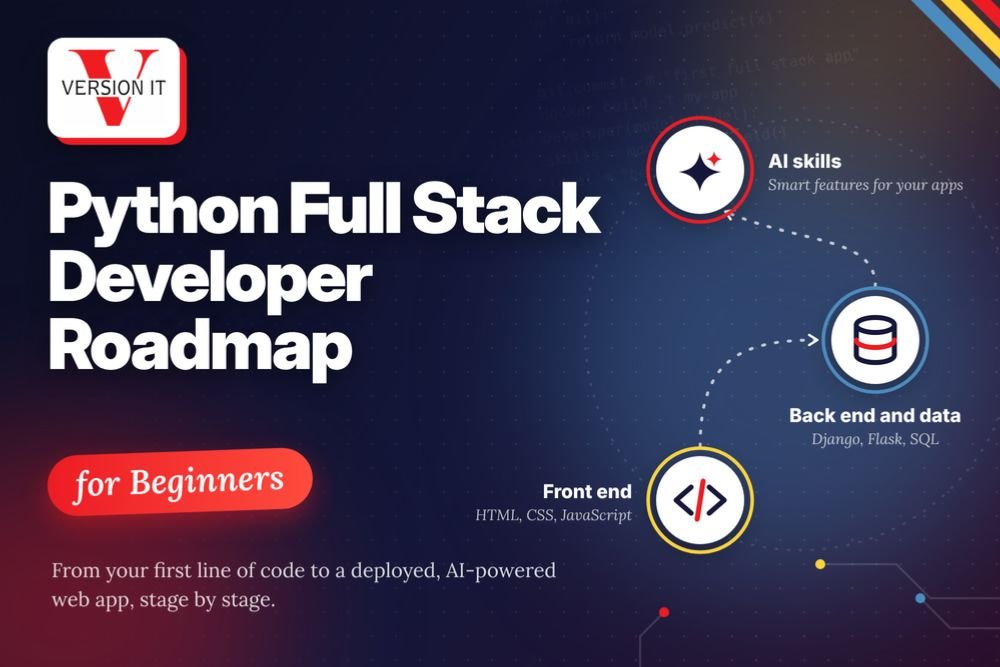
Every year, hundreds of graduates and working professionals ask the same question: how do I get into software development without feeling confused? Full stack development in Python offers one of the best solutions. With its help, you can do everything a user sees as well as everything going on behind the scenes. Thanks to this roadmap, you will be able to clearly understand what knowledge you need to gain at each stage of the learning process.
What is a Full Stack Developer’s Job Description?
Full stack developers handle the front end (where the user interface is) and back end (which consists of servers, databases, and logic of services). They grasp how the entire application functions, and thus are highly reputable among startups as well as big firms, as their ideas can be transformed into features.
Python is widely used for back end programming. It offers the advantages like the Django and Flask frameworks, assistance from big community, and the ability to use the programming language in modern technologies like machine learning. That is why many students in Hyderabad opt for Python Full Stack Training in Hyderabad education.
Stage 1: Study Basic Concepts of Python
Begin with the fundamentals of Python programming. You should not accelerate this part, since it determines everything that follows.
- Variables and data types
- Control flow and loops
- Functions and libraries
- Collections like lists, tuples, sets, and dictionaries
- File input/output and exception handling
- Object-oriented programming principles
Spend three to five weeks practicing here. Try writing simple programs on a daily basis, like a calculator or a to-do list.
Stage 2: Learn about Front-End Essentials
A developer with back-end inclination has to know some things about the working of browsers. You need to learn the following:
- HTML for the creation of page structures
- CSS for styling the page, including Flex box and Grid
- JavaScript for adding interactivity and working with the DOM
- Responsive design to enable your pages to be opened on phones and laptops
- A framework like React, that will be used once JavaScript is mastered
You can try making your portfolio and a simple landing page first.
Stage 3: Explore Backend Development With Python
This is when Python excels. Focus on one framework. Learn it well.
Django is a full-stack framework with built-in authentication system, admin interface and object-relational mapper. For larger projects. Another choice is Flask , a barebones framework that’s great for learning the internals of web apps. FastAPI is another good option. Its popularity is growing quickly thanks to the sub-second performance of its APIs.
Key learning topics:
- Routing and views
- Templates and rendering
- Forms and validation
- User authentication and authorization
- Building and consuming REST APIs
A Python Full Stack Course in Hyderabad would typically follow this order so that you do not make the mistake of jumping between tutorials in a random manner without accomplishing anything.
Step 4: Handling Databases
Looking at any application and you will find data involved. Learning to work with databases is essential.
- Graphical databases like MySQL or PostgreSQL: Learn about tables, indexes, normalization, etc.
- Non-SQL databases like MongoDB: learn when your document-based database can provide better solutions than SQL table-based ones replacing rigid schemas.
- ORMs such as Django ORM or SQLAlchemy for using Python to retrieve/save db content.
You can start with a library database or a database for an online shop and then link it to the backend.
Step 5: Learn the basics of version control and dev tools
Professional developers don’t often work alone, so get familiar with these collaboration tools:
- Git and GitHub – for versioning and working together.
- Command line fundamentals
- A code editor such as VS Code
- Postman – for API testing
- Some basic debugging techniques.
Make sure to keep all your projects in GitHub as many employers look for your repositories before reading your CV.
Stage 6: Understanding Deployment and DevOps Fundamentals
A project that only operates on your computer is incomplete. Try to learn how to make your apps available online like:
- Hosting on cloud computing solutions like AWS and others
- Using Docker to package apps
- Basics of CI/CD processes
- Environment variables and security of apps
- Web servers such as Nginx and Gunicorn
There is no need to become a specialist in DevOps field but just basic knowledge about deployment increases your chances to find work significantly.
Step 7: Apply Your AI Skills To The Job Search
In the fast-changing job market, developers with AI skills have a big advantage. If you want to learn how to combine web design with machine learning skills and generative AI skills, then Python Full Stack with AI Training in Hyderabad is the best.Be sure you get good at:
- Data processing using NumPy and Pandas
- Machine learning basics with scikit-learn
- Embed AI APIs into applications
- Developing chatbots and recommendation systems
- Learning prompt engineering and ethical AI use.
You do not need a research background. Just having an AI feature in a web app that offers a smart search or an intelligent assistant will make your portfolio stand out.
Stage 8: Create Real Projects
Projects are the test of knowledge learned. Plan for three or five real projects:
- A blogging system that has logins and comments
- An e-commerce website with a cart and payment system
- A job website that has a search engine and filters
- A task management application using REST API
- An app that uses AI, for instance, a CV analyzer or a support chatbot
Make clear README (README.md files) and deploy every project prepared to justify your design in interviews.
Stage 9: Prepare for Interviews
When your basic knowledge is already excellent, you can prepare as follows:
- Revise fundamental concepts in Python and OOP
- Learn about various data structures and algorithms by practicing online.
- Study SQL queries and database design
- Prepare to discuss the projects in detail
- Practice interviews.
Most of the learners believe that mentor feedback from an educational institution such as Version IT considerably eases the process of this stage.
Selecting the Best Learning Path
Self-study is effective for disciplined learners, however, an effective course provides direction, answers queries and guarantees accountability. While assessing a Python Full Stack Training Institute in Hyderabad, check whether:
- The curriculum is up-to-date in regard to the latest tools and AI technologies?
- Do all the trainers have real work experience?
- Are there any hands-on projects included apart from theory?
- Is the instruction and job placement support provided?
- Are there flexible options available, e.g. Python Full Stack Online Training in Hyderabad for busy people?
Institutions such as Version IT provide practical knowledge and project-based training, which leads graduates to leave with their work portfolio, rather than simple certificates.
A Realistic Timeline
If you are a beginner who is studying regularly, you can expect to get a job within six to nine months. The basics will take you around one month to complete, and the front end will take you another month to two months. After that, expect two to three months for the back end/deployment, databases, AI skills, projects, and interview preparation.
Conclusion
It is important to remember that becoming a Python full stack developer is not an instant process. You need to learn the basics, add knowledge of front and back end along with mastering the database and deploying the project. Most importantly, keep developing. With a good direction from a reliable center such as Version IT and constant work, you will be able to make this roadmap come true and take advantage of high perspective in the technology industry in Hyderabad.
Frequently Asked Questions FAQ’s:
1. Is Python full stack development is suitable for Begineers?
Yes. Python is a simple to understand language, need for full stack developers are high, and abilities are useful in different sectors. Learning the basis and developing projects step-by-step makes it an easy transition even if someone has no technical background.
2. Is it necessary to possess a degree in computer science in order to learn programming?
No. Many successful developers have come from various fields including commerce and many others. Employers are interested in your projects rather than educational qualifications.
3. How long would it take to become a full stack developer?
Most beginners are required to undergo training for around six months to nine months regularly.
4. Do I have to learn Django or Flask first?
If you want a full set of tools with fewer choices to make, then Django would be a better first option. If you want to learn more about web development basics, then Flask would be preferable. Either option works, or knowing one makes it easier to learn the other.
5. Does online training work as well as classroom training?
Yes, if the program offers live interactive classes, support from training supervisors and practical assignments. Choose a format you like and that fits your schedule, and be prepared to work on it daily if you want to see results.
Enquiry Form
Recent Posts
Python Full Stack Developer Roadmap for Beginners
Azure Data Engineer Training in Hyderabad with Placement Support at Version IT

Advanced Cyber Security Training in Hyderabad for IT Professionals
Data Science Training in Hyderabad at Version IT – Build Skills for Tomorrow’s Technology