
- Home
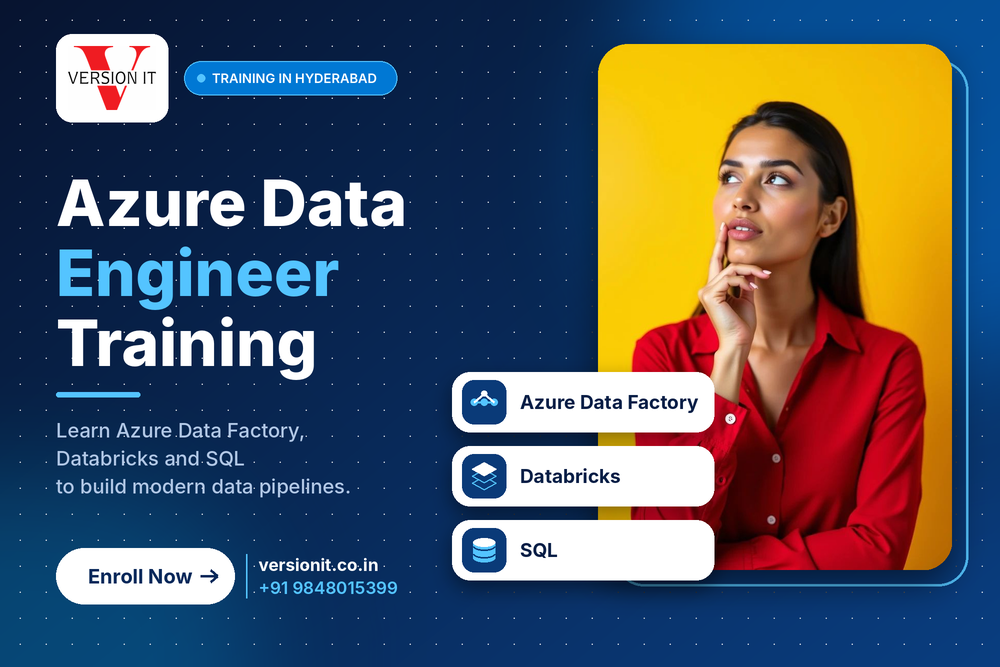
- Azure Data Engineer Training in Hyderabad: Learn Azure Data Factory, Databricks, and SQL.
Azure Data Engineer Training in Hyderabad: Learn Azure Data Factory, Databricks, and SQL.
- admin
Introduction
Organisations now have an abundance of information at their fingertips, collected from their websites, mobile applications, customer transactions, business processes, and cloud applications. Businesses in all industries have come to rely on efficiently handling this data and turning it into insightful business information. Hence, data engineering is an intriguing role for IT professionals seeking to work with cloud technologies and modern data platforms.
Azure Data Engineer Training in Hyderabad is a great chance for learners, recent graduates, working professionals, and people changing careers to discover cloud data engineering skills. Learning about Microsoft Azure services will allow them to collect, convert, save, manage, and analyze data of any amount.
Version IT offers students the chance to study complex concepts and technologies behind Azure data engineering, such as Azure Data Factory, Azure Databricks, SQL, and cloud data pipelines. Students can be educated about their use and the incorporation of such tools into their real-world data engineering projects, which can help prepare students for their future careers.
If you are a new starter in your IT journey or want to enhance your technical skills, you will find enough insights on Azure data engineering to understand the approach businesses take to manage data in the cloud these days.
What Is Azure Data Engineering?
Azure data engineering is the design, construction and maintenance of data systems that leverages technologies provided by Microsoft Azure. Azure data engineers design data pipelines to transfer data from various sources to a centralized data store, where it is transformed, structured, and prepared for reporting, analysis and machine learning.
For example, an ecommerce company can collect information such as the number of purchases made by their customers, the products available, the number of visits to their website and the number of transactions. This data is then used to develop cloud simplifications, where they integrate the data, remove errors and inconsistencies and provide trusted information to business analysts and decision makers.
The following technologies might use to be utilized by an Azure data engineer:
- Azure Data Factory to integrate and orchestrate data.
- Azure Databricks for large scale data processing and transformation.
- Query, clean and manage structured data using SQL.
- Azure Data Lake Storage, for storage of data at different stages of processing.
- Based on the organization’s data architecture, either Microsoft Fabric or Azure Synapse Analytics.
- Python for Automation and Data Transformation Tasks.
Azure Data Engineer Training institute in Hyderabad at Version IT can provide insights into these technologies and how they can be applied in various real-world data workflows.
Why Choose Azure Data Engineer Training in Hyderabad?
The IT services, consulting firms, product organizations, and cloud technology-based businesses are growing in Hyderabad. Cloud platforms are a great way for many organizations to modernize their data infrastructure and enhance operations.
Understanding the concepts of Azure data engineering can enable you to acquire skills that are applicable in these technology scenarios.
Create In-Demand Technical Skills
There are various fundamental skills that every data engineer needs to know, such as database theory and principles, basic programming, understanding of cloud computing, and knowledge of data transformation techniques. A formal training program teaches these skills to the students in a systematic manner, rather than requiring them to learn the skills one at a time by studying individual technologies.
Develop familiarity with SQL queries, data pipeline development, data transformation, workflow orchestration and cloud storage.
Understand Cloud-Based Data Platforms
The traditional data systems can be on-premises infrastructure. Cloud platforms offer scalable computing and storage options for organisations to adapt to their needs.
Azure data engineering will enable students to learn about cloud-based solutions for processing ever increasing business data.
Refer to a couple real-world examples of data workflow capabilities.
It is important to understand individual mechanisms and tools, but it is equally important for data engineers to know how to apply all those tools in practice. For example, you can use Azure Data Factory to move data, Databricks to process data and SQL to analyze the data.
We can demonstrate how data engineering projects are done in real life by letting learners experience such workflows.
Find Other Job Opportunities
Azure Data Engineering skills can be used in jobs like Azure Data Engineer, Junior Data Engineer, Data Integration Developer, ETL Developer or Cloud Data Engineer.
The truth is that every employer has his own demands, so it is necessary to take into account factors such as previous experience or the demands of the chosen project.
Learn Azure Data Factory for Data Integration
Azure Data Factory (ADF) is a cloud service for data integration which allows the user to create and maintain data pipelines. The service allows the user to transfer and transform big amount of data from one system to another.
Data engineers rely on ADF to coordinate the movement of data from various data sources including databases, downloaded files, apps and other supported system to storage or processing locations.
Key Azure Data Factory Concepts
The following concepts must be mastered by learners during Azure Data Engineer Training in Hyderabad:
Pipelines: Pipelines consist of the operations responsible for carrying out a specific data integration process.
Activities: Activities are the basic functions performed such as copying data, executing a transformation, or carrying out a supported processing procedure.
Datasets: These are composed of information on the structure and location of the data used in the pipeline’s activities.
Linked services: Linked services establish required connection information for computing services and data stores.
Triggers: Triggers launch pipelines based on predefined conditions.
Integration Runtime: This refers to the environment in which the movement of data is implemented and processes are carried out.
Example of an Azure Data Factory Project
A retail firm records its sales in the database daily and desires to send the records to the cloud for reporting purposes. The following actions can be carried out by the Azure Data Factory workflow:
- Establish connection to the source database.
- Fetch sales records for a selected time period.
- Transfer the data to Azure Data Lake Storage.
- Conduct validation or transformation tasks
- Schedule pipeline runs on a daily basis.
- Monitor the process and check for failed runs.
Thus, this is how Azure Data Factory contributes to logistics automation.
The process of developing pipelines, establishing connections, configuring parameters, and overseeing execution helps learners to have better insights into data orchestration.
Master Azure Databricks for Big Data Processing
Azure Databricks is considered as a cloud computing data analysis platform that is based on the technology of Apache Spark and is able to facilitate high volume data processing and data engineering work done with data analysis and machine learning operations.
Under the circumstances of dealing with millions of records and combining information received from different sources, the traditional processing methods may not be applicable anymore.
Important Azure Databricks Skills
A well-structured learning path should introduce learners to:
- Databricks workspaces and notebooks.
- Apache Spark fundamentals.
- DataFrames and Spark SQL.
- Data cleaning and transformation.
- Batch data processing.
- Delta Lake concepts and reliable data storage.
- Job scheduling and workflow orchestration.
- Performance optimization and troubleshooting.
Depending on the project, learners may also use Python, SQL, or other supported languages to process data.
How Databricks Works in a Data Engineering Pipeline
Consider a business taking customer orders from various locations. The received data may be incomplete, may contain superfluous info, may show date in a manner the data warehouse cannot interpret or may include wrong info.
The steps in the workflow of Databricks will include:
- Using cloud storage and reading raw data
- Finding unknown or incorrect numbers
- Removing redundant info and normalizing data types
- Using business rules and performing calculations
- Storing the cleansed data in a suitable format
- Providing processed data for reporting or analysis.
The above tasks will assist the downstream processing of data enabling its successful use in the future.
It would be helpful to use Azure Databricks along with Azure Data Factory because they supplement each other. In this instance Data Factory will schedule and trigger the Databricks process being performed.
Build Strong SQL Skills for Data Engineering
Structured Query Language (SQL) is one of the most important skills that must be acquired in the field of working with relational databases and structured data. A good example of an Azure Data Engineer using SQL is when they access and transform data, verify the data, and carry out data quality analysis.
Though a cloud platform has visual interface and automation, it is still important to be well-versed in SQL.
Key SQL principles to learn.
In the Azure Data Engineer training program, participants are expected to develop the following skills:
Fundamentals: The ability to gather and filter data using SELECT, WHERE, ORDER BY, and DISTINCT.
Joins: The method of joining tables using INNER JOIN, LEFT JOIN and other join types.
Data aggregation using the aggregation techniques of COUNT, SUM, AVG, MIN, and MAX.
Group results: The use of GROUP BY and HAVING clauses.
The understanding of the application of Common Table Expressions and Subqueries to simplify the complexity of practical tasks.
Window functions: such as the application of the ROW_NUMBER () and RANK () functions.
Data Modification: Knowing about INSERT, UPDATE and DELETE.
Data validation: Detect duplicate, missing, inconsistent data and unexpected data.
Practical SQL Example
Suppose a sales table contains the columns order_id, customer_id, order_date, and sales_amount. A data engineer may need to calculate total sales for each customer.
SELECT
customer_id,
SUM(sales_amount) AS total_sales
FROM sales
GROUP BY customer_id
ORDER BY total_sales DESC;
The purpose of this query is to group the transactions into categories based on the customer as well as calculate the total sales that have been made to each of the customers.
Knowledge of SQL becomes more valuable with the combination of Azure services. The application of SQL will allow you to study the original data, validate the results of transformations, as well as prepare the data for reporting.
Understand How Azure Data Factory, Databricks, and SQL Work Together
A key aim of attending Azure Data Engineer Training in Hyderabad is to understand how different technologies are integrated to build an entire data pipeline.
Several technologies can be employed for the different processes However, when combined together, companies set up an efficient data processing.
An example can be illustrated where a finance enterprise might obtain transactions data from a number of business software systems. In this case, Azure Data Factory performs data collection, Azure Data Lake Storage keeps the raw files and Databricks works on data conversion. At the end, SQL enables analyzing results and detecting errors.
Hands-On Projects for Azure Data Engineer Training
Practical implementation projects play an important role in knowledge acquisition as they allow for linking theoretical knowledge to specific technical tasks. While choosing an Azure Data Engineer Training Institute in Hyderabad make sure you have access to the practical training as part of your course that consists of working on actual workflows related to data.
Here are three project ideas that learners can explore.
Project 1: Retail Sales Data Pipeline
Objective: Automate the ingestion and processing of daily retail sales data.
Tasks may include:
- Ingest CSV files using Azure Data Factory.
- Store raw files in Azure Data Lake Storage.
- Process records using Azure Databricks.
- Use SQL to validate sales totals.
- Create a curated dataset for reporting.
This project introduces data ingestion, transformation, validation, and orchestration.
Project 2: Customer Data Integration
Objective: All customer data should be connected together into a single unit of data.
Multiple processes would be performed to find duplicates in customers, combining information and standardizing names and addresses, filling in the gaps in missing information, and joining similar records.
Transformations in SQL could be made as well as managing the progress of the work from Azure Data Factory and Databricks.
Project 3: Employee Analytics Data Pipeline
Objective: Data sets to report to the organization about employees.
The workflow may integrate employee records, department data and attendance records. Students can scrub the data, sum it up on a department level and check the resulting metrics.
These projects can allow a student to develop a portfolio which will showcase their skills. But completion of project is not sufficient for getting a job; the concepts behind the implementation of these projects also need to be understood.
Who Should Enroll in Azure Data Engineer Training?
Azure data engineering provides opportunities for people with different backgrounds and fields of study.
Fresh graduates: Students with either an IT background or working in related fields can get training and skills required for working in the cloud.
Those already in the IT industry: software developers and database experts with expertise in SQL or ETL can have further training in Azure data services to increase their expertise.
Data analysts: Individuals who have interest in areas such as ETL or data ingestion will find that the data engineering area is a promising direction for them.
Individuals switching careers: If individuals would want to venture into cloud-based jobs, it is recommended to start with acquiring knowledge of programming and SQL.
The knowledge of basic programming concepts in addition to database knowledge will help provide a smoother transition.
Career Opportunities after Azure Data Engineer Training
The companies in diverse sectors employ data in their systems for planning, finding customers, financial reporting, ensuring logistics, and making plans in their daily activities. This gives rise to the demand for people skilled in creation and employment of dependable data systems.
After developing suitable technical skills and practical experience, learners may explore roles such as:
- Junior Azure Data Engineer
- Azure Data Engineer
- ETL Developer
- Data Integration Developer
- Cloud Data Engineer
- Data Platform Engineer
These positions are not similar. In entry-level jobs, you will mostly be helping senior engineers, writing SQL queries, checking data, and looking after current pipelines. Higher-level positions may imply building scalable systems architecture, improving mechanisms, maintaining safety and making complex data-processing centers.
You should master theory of SQL problems ahead of the interview. It would be good to know basic Python scripting and be ready to describe your projects well. You also need to learn about the architecture of data pipeline systems.
Why Choose Version IT for Azure Data Engineer Training in Hyderabad?
Selecting a training agency is a major milestone to take at the start of the cloud data engineering course. Learners will have to take into consideration course syllabus, trainer experience, hands-on activities, learning support, and the applicability of the technologies in question.
At Version IT, learners can check the Azure Data Engineer Course in Hyderabad to get to know which options they have for acquiring skills in cloud data engineering.
Before signing up, one has to find out if the program addresses the following.
Prior to deciding on the enrollment, make sure that the course encompasses the following topics:
- Azure data engineering fundamentals.
- Azure Data Factory pipelines and orchestration.
- Azure Databricks and Spark-based processing.
- SQL queries and data validation.
- Cloud storage and data architecture concepts.
- Practical exercises and end-to-end project workflows.
- Troubleshooting, monitoring, and interview preparation.
Speak to the personnel from the training team regarding present syllabus topics, labs for practice, ongoing projects, batch timings, trainer availability, etc so that the desired program may be finalized.
Look at the website htpps//:versionit.co.in for available training programs and more course details.
Tips for Succeeding as an Azure Data Engineer
As for SQL itself, you should practice filtering, combining, aggregating, sub querying, and working with window functions using sample data.
One should review the fundamentals of the cloud including: storage, processing basics, network and identification and authorisation subjects.
Study Azure Data Factory, managing pipelines and their probable problems.
Know how to use DataFrames and Spark SQL.
Conduct complete projects by combining ingestion, storage, processing, and confirming into one project.
Be ready to encounter difficulties: failed activities, wrong data types, omitted data, performance issues, etc.
Keep learning: Azure services are constantly evolving. Follow the latest MS Learning documentation.
Conclusion
Azure data engineering represents a convergence of cloud computing, data integration, distributed processing, and database skills that equip businesses and organizations with successful information management capabilities. The ability to create modern data pipelines is based on the expertise in the use of Azure Data Factory, Azure Databricks, and SQL.
Version IT Azure Data Engineer Training in Hyderabad may represent a unique opportunity for learning for students, newcomers, and working professionals eager to develop skills for embracing cloud data engineering. Through workshop projects, practical activities, and theoretical aspects, students acquire all skills that can be applied in data engineering jobs.
To kick off your career in the field of cloud data engineering, it is recommended to go from SQL and cloud simplifications to learning what data pipelines and Databricks are and finish by implementing a full workflow using real data.
Enquiry Form
Recent Posts
Azure Data Engineer Training in Hyderabad: Learn Azure Data Factory, Databricks, and SQL.

Top 5 Benefits of Snowflake Training in Hyderabad for Students and Freshers

6 Generative AI Tools and Technologies Every Learner Should Know
Data Science Training in Hyderabad: Course, Fees, Syllabus & Placements