- Home
- 6 Generative AI Tools and Technologies Every Learner Should Know
6 Generative AI Tools and Technologies Every Learner Should Know
- admin
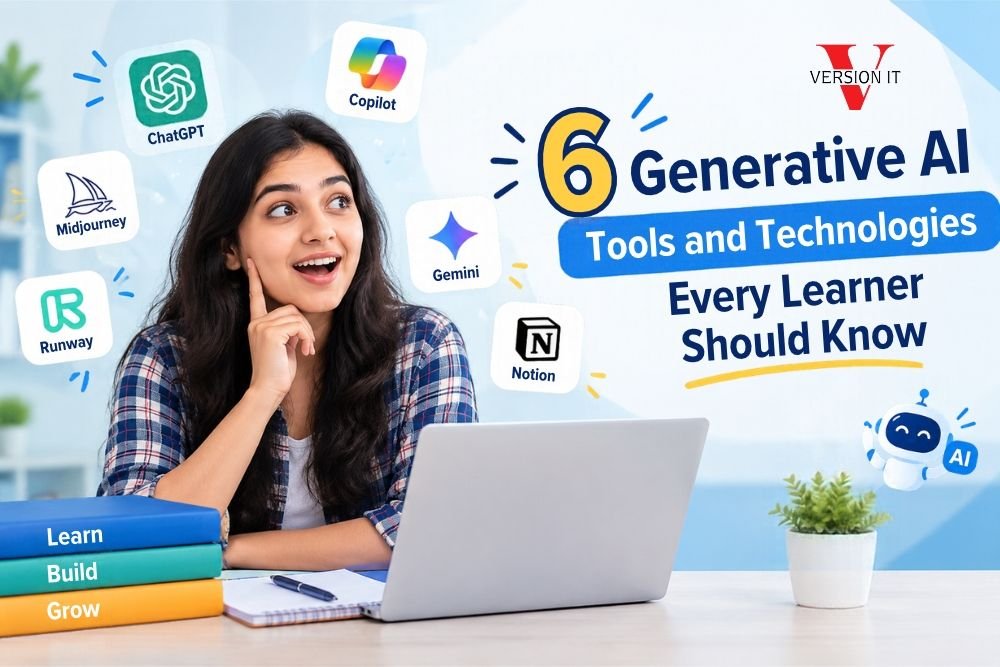
Generative AI is not only evolving, leaving text-generating methods, but also extending into systems capable of search and retrieval, document manipulation, access to third-party applications, and multistage tasks. To learners, it is more beneficial when they know how these applications work rather than knowing how to use an AI chatbot.
A systematic Generative AI Course in Hyderabad can offer a learning trajectory, learners must also be familiar with the key technologies that are used to develop and deploy Generative AI applications. The six areas below give a practical basis on how to move forward on the development of AI and application development starting with the basics of AI.
1. Large Language Models (LLMs)
A series of Generative AI applications depend on the use of Large Language Models or LLMs. They are trained on massive data and may produce and manipulate text as per the user inputs and application instructions.
Learners should understand concepts such as:
- Tokens and context windows.
- Predicted inputs and outputs.
- Training and inference
- System and user instructions.
- Model limitations
- Generation settings temperature and other settings.
- Model selection
LLMs can be used for applications such as conversational assistants, summarization, content generation, coding assistance, and question-answering systems.
Knowledge on how models respond to prompts and produce responses can be used to learn more advanced Generative AI technologies.
2. Prompt Engineering
Prompt engineering consists of writing prompts and inputs that guide an AI model to a target response.
- Useful concepts include:
- Clear task instructions
- Context provision
- Few-shot prompting and examples.
- Output formatting
- Role and system directions.
- Prompt evaluation
- Structured outputs
Good prompting does not merely mean writing longer instructions. The task is to present the model with the information and limitations needed to give worthwhile and consistent results.
The Generative AI Online Training in Hyderabad allows learners to practice and design on a timely basis using various tasks and contrast the influence of the instructions alteration on model responses.
3. Retrieval-Augmented Generation (RAG)
RAG or Retrieval -Augmented Generation is a form of information retrieval and generative AI.
A RAG application can also use information read in a chosen source of knowledge and supply that information to the model rather than just using the information encoded in a model.
The common RAG process includes:
- User query → Find applicable data → Create context to model → Response.
- RAG can be used for:
- Document question answering
- Internal knowledge assistants
- Technical documentation search
- Customer support applications
- Enterprise knowledge systems
Students ought to learn how to process documents, chunk, embeddings, retrieval and context building when learning RAG.
4. Vector Databases and Embeddings.
Embeddings formulate the information as numerical vectors which form the relationships among contents. They are widely applied in semantic search and in RAG systems.
The representations are supposed to be stored and retrieved in efficient databases known as Vectors databases.
Important concepts include:
- Embeddings
- Vector representations
- Similarity search
- Semantic search
- Metadata
- Chunking
- Indexing
As an example, an application can turn a question posed by a user on a set of documents into an embedding and find material that has a similar meaning.
Learners should understand embeddings and vector search as part of the effort to create knowledge-based Generative AI applications.
5. Generative AI APIs and Application Frames.
APIs allow developers to incorporate AI models into their applications. It enables a webpage, mobile application, business system, or an internal tool to feed information to an AI model and utilize the results received back.
Learners should understand:
- API request and response.
- Authentication
- API keys
- JSON
- Error handling
- Rate limits
- Model parameters
- Application integration
Python is also especially amenable to the development of Generative AI since it offers a huge ecosystem of APIs, data processing, machine learning, and application development.
This is the reason why Python with Generative AI Training in Hyderabad may be helpful to learners who should no longer use AI tools and begin creating AI-powered applications.
6. AI Tool Use and Agents.
AI agents build on Generative AI applications and provide the models with the ability to message tools and run a series of actions based on a specific workflow.
An AI agent can potentially:
- Retrieve information
- Call APIs
- Browse and search a library.
- Execute predefined functions
- Process data
- Perform multi-step tasks
The idea of agentic AI contrasts with the mere notion of just prompting an LLM to write. A model reasoning can be merged with tools and memory or state, and application-defined actions used by an agent-based system.
As learners ponder on Generative AI and Agentic AI Training in Hyderabad, the concept of tool calling, workflow, retrieval and task decomposition is a valuable starting point.
How to develop your generative AI technology skills.
All the six technologies mentioned above are interrelated and not standalone subjects. An effective learning pathway could start with the basics of LLCM and prompt engineering and move on to embeddings, vector databases, RAG, APIs, and agentic workflows.
These concepts can be then linked through Python to produce working applications.
An example is a learner may create a document assistant that:
- Accepts uploaded documents.
- Divides the material into smaller parts.
- Creates embeddings.
- Embeds the embeddings in a vector database.
- Retrieves relevant information.
- Passes the context fetched to an LLM.
- Produces a response to the user.
- Such a project is an example of a collaboration among several Generative AI technologies.
Generative AI Training institute in Hyderabad like Version IT assist learners to pursue this development by taking part in guided lessons and projects. The Generative AI training provided by Version IT can assist learners in building knowledge in terms of relevant AI concepts and technologies.
However, focusing mainly on learners who are interested in programming, Python with Gen AI Training in Hyderabad can offer an avenue of entry into developing Python development and Generative AI application development.
FAQs
1. What are the Generative AI technologies that are critical to study?
Notable technologies to learners who want to develop applications of Generative AI include LLPMs, prompt engineering, RAG, embeddings, and vector databases, AI APIs, agentic AI.
2. Do I need Python to learn Generative AI?
Python does not apply to all Generative AI positions, but it is still very helpful in the creation of AI applications, in interactions with APIs, data processing, and in the incorporation of AI models.
3. What is RAG in Generative AI?
RAG enables an AI application to access relevant information to a knowledge source outside of itself and make it available to a generative model to use as context to produce a response.
4. What is the difference between Generative AI and Agentic AI?
The most common type of content that generative AI systems create is text, code, images, or any other output. Multi-step tasks can be implemented by two models with tools and workflows, which can be executed by agentic AI systems.
5. Are they accessible to beginners in these Generative AI technologies?
Yes. Novices can learn with AI and Python basics, followed by LLMs, prompting, APIs, RAG, embeddings, and agentic workflows in a structured way and in projects guided by real-world projects.
Enquiry Form
Recent Posts
6 Generative AI Tools and Technologies Every Learner Should Know
Data Science Training in Hyderabad: Course, Fees, Syllabus & Placements

How Can GCP Data Engineer Training Help Students Start Their Tech Careers?