
- Home
- How Can Agentic AI Training Help Developers Debug Unpredictable Agent Behaviour?
How Can Agentic AI Training Help Developers Debug Unpredictable Agent Behaviour?
- admin
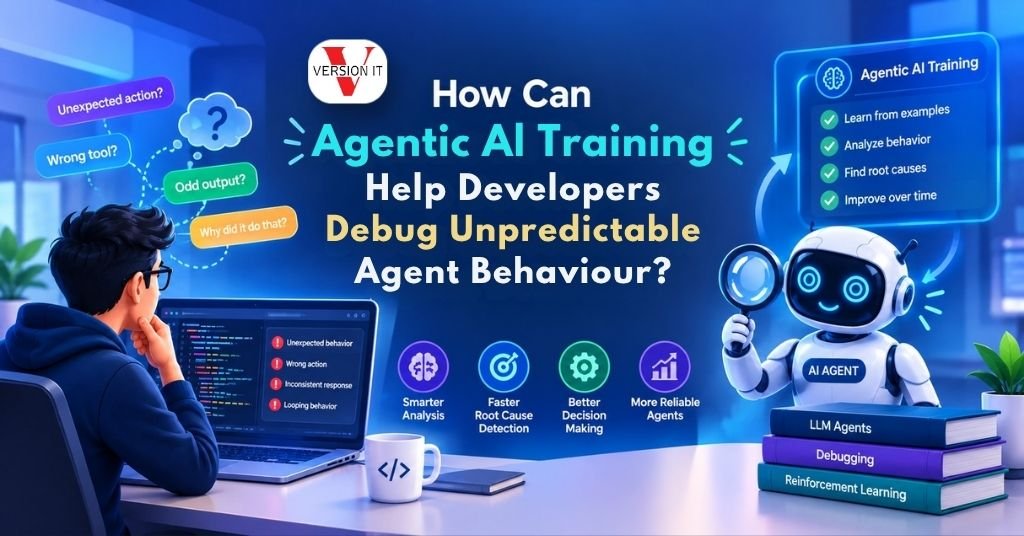
The AI agents are becoming independent. Modern agents are able to plan, call tools, retrieve information, make decisions, maintain context, and adapt their actions in response to results, as opposed to merely reacting to a prompt. This flexibility also poses a great problem to developers; why did an agent act like that when it was not supposed to?
The well-known methods of debugging do not always work in case an AI agent gives unpredictable answers. The developers should not only know the code, but also prompts, model outputs, tool calls, memory, context, and decision-making paths.
It is at this point that Agentic AI Training in Hyderabad can assist developers to develop pragmatic skills in identifying, replicating and correcting unforeseen agent conduct.
What Makes Agent Behavior Difficult to Debug?
There are multiple elements that affect an agent. Having a seemingly minor alteration in a single component could result in an entirely different outcome.
As an illustration, a customer-information retrieving-agent can:
- Choose an inappropriate tool.
- Produce a falsely generated API argument.
- Do it again.
- Ignore an instruction.
- Give varying outputs to similar inputs.
- Lost key context in a protracted workflow.
- Stop before completing a task.
- Become lost in a logic or behavioral trap.
AI agents may include probabilistic model behavior as opposed to standard software, where a given input usually results in consistent execution.
The debugging process required by developers must therefore look at the complete agent workflow and not just be focused on application code.
How Does Agentic AI Training Help Developers Debug Agents?
Agentic AI Training in Hyderabad teaches developers how to approach agents as observable, testable systems. Rather than asking just, what went wrong, developers know how to probe where the behavior shifted and what component triggered the behavior.
An effective training program usually includes such aspects:
- Agent architecture
- Instructional design Timely.
- Tool calling
- When used in context and memory management.
- Agent tracing
- Evaluation frameworks
- Error handling
- Observability
- Multi-agent workflows
- Testing and optimization
This provides developers with an organized path to go through the unexpected output to the underlying cause.
Debugging Starts With Agent Tracing
Tracing is one of the most crucial skills that are learned during an Agentic AI Course in Hyderabad.
The last answer is not always a way in which an agent made its decision. Documenting key events during the working process, including:
- User input
- System instructions
- Model response
- Tool selection
- Tool parameters
- Tool output
- Memory retrieval
- Intermediate state
- Final response
Consider an agent that gives an incorrect product recommendation. The response given at the end can be taken to indicate a model problem.
Tracing may show that the model has chosen an inappropriate database tool or that the retrieval component has provided old information.
This difference is essential since developers are able to correct the appropriate layer, rather than repeatably altering the prompt.
Can Prompt Engineering Reduce Unpredictable Behavior?
Yes. The instructions may be poorly constructed to cause ambiguity, particularly in situations where the agent has more than one tool or objective that are not simple to achieve.
Developers can be trained on how to develop more understandable agent instructions through Agentic AI Online Training in Hyderabad.
Good prompts ought to characterize:
- The agent’s role
- Available tools
- When each tool should be used
- Input and output formats needed.
- Constraints
- Failure-handling behavior
- Conditions for asking the user for clarification
- Terms of discontinuation.
As an example, rather than issuing a command to an agent like find customer information, one can specify the tool to be used, the fields which are necessary, how to process missing information and when the workflow should be stopped.
Improved instructions do not remove model variability, but can in a large way decrease unnecessary ambiguity.
Why Tool-Calling Skills Matter
Numerous unforeseeable agent actions are external to the language model.
An agent might make the correct decision to make an API call and produce an invalid parameter. It may choose a search tool where a database search was needed. It might also invoke the same tool multiple times since the workflow does not have a suitable termination condition.
A Advisor AI Online Course in Hyderabad can assist developers to learn how to create safer tool-calling workflows.
Developers are to learn to verify:
Component | What Developers Should Check |
Tool selection | Did the agent choose the correct tool? |
Parameters | Were arguments valid and complete? |
API response | Did the tool return usable information? |
Error handling | Was the failure handled correctly? |
Retry logic | Could retries create loops? |
Termination | Does the agent know when to stop? |
This makes tool execution more predictable and easier to troubleshoot.
Testing Agent Behavior With Realistic Scenarios
Once is not enough in debugging an agent. Designers require reproducible assessments.
Training may expose developers to test cases that intentionally cause an agent to be challenged.
Test scenarios of use are:
- Ambiguous user requests
- Missing information
- Invalid tool responses
- Conflicting instructions
- Unexpected API failures
- Long conversations
- Incorrect retrieved documents
- Repeated tool calls
- Bad or unrelated inputs.
Developers are able to compare the outputs of the agents in many runs and to note the patterns of failures that happen repeatedly.
This is particularly necessary since the agent may pass in one test and fail when in slightly different conditions.
Observability Makes Agent Failures Easier to Understand
The errors, latency, and infrastructure performance are some of the common traditional application monitoring aspects. There is a need of more visibility of model and workflow behavior in agent systems.
Measures that developers should track include:
- Tool-call success rate
- Task completion rate
- Agent latency
- Number of model calls
- Number of tool calls
- Retry frequency
- Failure categories
- Token usage
- Evaluation scores
This information can help developers identify whether a problem is isolated or systemic or not.
To illustrate, when an agent makes an immediate change and begins to invoke three times as many tool calls that might be thought to be a prompt regression, a tool response error, or a faulty stopping condition.
Building a Systematic Debugging Workflow
An effective debugging process can take five steps:
Step 1: Recreate the behavior.
Record the actual user input, settings, model version and tools and the context.
Step 2: Trace the workflow
Examine the selections and tool invocations of the agent, accessed information and intermediary results.
Step 3: Find the failure level.
Find out which of the following is the source of the problem: the prompt, model, tool, retrieval system, memory, application logic, or external API.
Step 4: Implement a fix target.
Whenever possible change the component that is causing the problem.
Step 5: Evaluate again
Test the original test and associated edge cases to ensure that the fix does not introduce new failures, but instead positively influences behavior.
This method is far more dependable than going through prompts repeatedly until the agent randomly gives the desired response.
Conclusion
Unpredictable agent behavior is one of the biggest challenges in developing autonomous AI applications. Since an agent is a combination of models, prompts, tools, memory, retrieval, APIs, and workflow logic, debugging an agent is not as simple as software troubleshooting.
Agentic AI Training in Hyderabad can assist developers in acquiring such a skill set by training on tracing, evaluation, prompt engineering, tool monitoring, observability, and systematic testing.
The best developers will not consider an AI agent as a black box. They will develop observed, measurable, testable, and continuously improving agents.
FAQs
1. What is Agentic AI Training in Hyderabad?
The Hyderabad-based training programme, Agentic AI Training is a specialized course that aims at creating autonomous AI systems capable of planning, using tools, retrieving information, decision-making, and multi-step workflows. It may also address timely engineering, agent testing, debugging, observability, memory, RAG, and multi-agent designs.
2. Who ought to attend an Agentic AI Course in Hyderabad?
The course may be of use to software developers, AI engineers, ML engineers, data scientists, automation developers, and technology professionals who may want to create AI-powered applications. Python developers who have a basic understanding of machine learning or generative AI may find it more straightforward to advance to more advanced conceptual agent development.
3. Does Agentic AI Online Training in Hyderabad assist in debugging?
Yes. Created in Hyderabad, an effective Agentic AI Online Training program can provide developers with the skills to trace agent workflows, examine tool invocations, test outputs, detect timely issues, track failures, and test various scenarios. These abilities assist developers to diagnose unpredictable behavior in a systematic way rather than through trial and error.
4. What does an Agentic AI Online Course in Hyderabad entail?
A Hyderabad AI agent architecture, prompt engineering, LLM integration, tool calling, RAG, memory, agent orchestration, multi-agent systems, evaluation, observability, debugging, and deployment are some of the topics that may be included in an Agentic AI Online Course in Hyderabad. Practical projects are also specific to the learning process of how these components interact in practice.
5. Does Agentic AI require developers to learn?
The challenge will be based on the prior understanding of a programmer and AI. Those developers who have experience with Python, APIs, LLMs, and simple concepts of generative AI can build a powerful foundation faster. The learning process can be facilitated by structured training which entails integrating agent architecture, implementation, testing, and debugging in the form of practical projects.
Enquiry Form
Recent Posts
How Can Agentic AI Training Help Developers Debug Unpredictable Agent Behaviour?


SOC Analyst Training In Chennai: Learn Threat Detection Skills

How to Build a Strong Portfolio After Python Full Stack Training in Hyderabad