- Home
- Generative AI Training in Bangalore: APIs, Langchain, RAG, and Deployment Skills
Generative AI Training in Bangalore: APIs, Langchain, RAG, and Deployment Skills
- admin
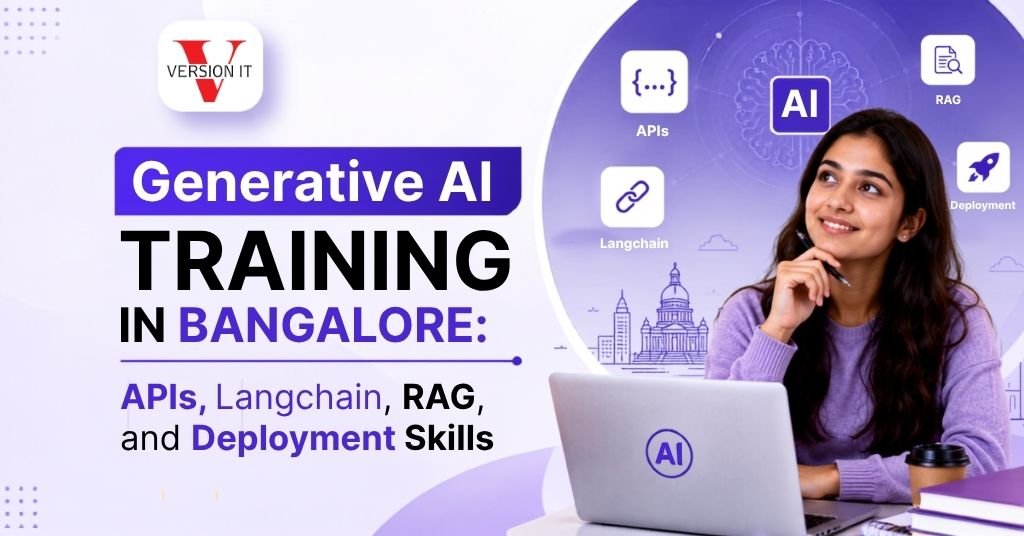
Generative AI is transforming the way developers develop apps, automate tasks, find information, and design smart online experiences. Whether it is AI assistants and document search systems, customer support apps, or content-generation tools, organizations are looking to find ways to incorporate generative AI into software products.
Generative AI Training in Bangalore may offer a systematic way to learn about large language models, APIs, LangChain, Retrieval-Augmented Generation, Python, vector databases, and deployment, to learners who wish to have practical exposure to these technologies. Rather than concentrating solely on prompts, a multi-faceted learning journey will assist learners to learn about the entire generative AI application design, connected, tested, and deployed process.
In the sections below, five key areas that learners can investigate when acquiring practical generative AI skills have been explained.
1. Establish a solid Generative AI, Python and API base.
The first step in creating generative AI applications is to grasp the interaction between language models and software systems. Small language models can be used to generate text, summarize documents, answer questions, help with coding, and process various types of unstructured information. But these capabilities require more programming and integration capabilities of the developers to convert them into useful applications.
Python is commonly employed in the development of AI due to its simple syntax and rich library and framework ecosystem. A Python With Gen AI Training in Bangalore course can assist students in learning to integrate the basics of Python with real-world AI development.
Python concepts that might be important include:
- Variables and data types.
- Conditional statements
- Loops
- Functions
- Lists and dictionaries
- Object-oriented programming
- Modules and packages
- File handling
- Exception handling
After grasping the basics of Python, the learners will be able to start dealing with APIs.
An API is a communication between two software applications. APIs are often utilized in the development of generative AI to request prompts or data to an AI model and generate a response.
Students enrolled in the Gen AI Training in Bangalore can learn about API endpoints, authentication, API keys, request methods, JSON data, response management, and error management.
As an example, a developer can use Python application to receive a user question, forward it to the AI model via an API, process the response received and show it in a web interface.
This understanding of this workflow is the basis of more sophisticated generative AI applications.
2. Learn LangChain for Building Connected AI Workflows
Basic applications of AI can entail a single prompts to a model and one response. Higher level applications can be multi-step and require multiple steps.
The application might be required to access data in documents, manipulate the data, construct a prompt, pass the prompt to a language model, process the response generated, and provide the result to the user.
These components are often organized and connected with the help of LangChain.
In a practical Generative AI Course in Bangalore, learners can be exposed to concepts of LangChain including:
- Prompt templates
- Model integrations
- Chains
- Document loaders
- Retrievers
- Tools
- Output parsers
- Memory concepts
- Structured workflows
Consider an AI-based document assistant. One of the users poses a question regarding the technical documentation of a company. The application will not pass the question to a language model but will first search the available documents to find out relevant information.
That information is then added as a backdrop and the model then comes up with an answer.
The various steps to this process can be bridged with the assistance of LangChain.
To learn how different frameworks like LangChain can assist them in going beyond simple examples of chatbots and start utilizing artificial intelligence models with business data, databases, third-party applications, and their own logic in creating applications.
Learners should also be aware of the flow behind the applications instead of wholly hinged on a framework. This simplifies the process of troubleshooting, optimization or replacement of individual components in case of changes in project requirements.
3. Learn about RAG, Embeddings, and Vector Databases
Another term used in the development of modern generative AI application is Retrieval-Augmented Generation or RAG.
Even large language models do not necessarily have access to all the confidential documents, internal databases, or recent sources of information. RAG is used to access the appropriate external information and give it to the language model as extra context.
A standard workflow of RAG contains a number of steps:
- Collect documents or information.
- Break down the content into small digestible bits.
- Create embeddings of those parts.
- Embeddings: Store the embeddings in a vector database.
- Receive a user request.
- Find semantically related information.
- Recall the most related passages.
- Add the model prompts with the content retrieved.
- Produce an answer based on the information provided.
Embeddings are numerical representations which enable applications to compare information based on meaning, as opposed to exact keyword matches.
As an example, a user would enter the query How can I change my login password? whereas the document in question is named as Updating Account Credentials. The relationship between these phrases can be identified with the help of semantic search.
Embeddings are stored in vector databases and can be used to search using similarity.
Students studying Generative AI Training in Bangalore will find it helpful to learn the interplay between embeddings, retrieval, and vector databases and language models since they are often utilized in knowledge assistants, document search systems, enterprise AI tools, and question-answering applications.
A practical project that can be useful is RAG based PDF question-answer application. Learners are able to upload documents, process the content, create embeddings, find corresponding sections, and create answers in accordance to the retrieved information.
4. Build Practical Generative AI Applications and Evaluate the Performance
A key aspect of learning generative AI is project development since it unites various technologies.
Using Generative AI Online Training in Bangalore, students can train on building applications, which include Python, APIs, LangChain, RAG, vector databases, and web development technologies.
Possible projects could be:
- Artificial intelligence (AI) customer care.
- PDF question-answering application
- Internal knowledge assistant
- Artificial intelligence (AI) content summary tool.
- Resume analysis application
- AI-powered search system
- Product information assistant
- Research document analyzer
- Developing these applications can make learners comprehend the flow of data in an AI system.
- Testing is also imperative.
Generative AI responses can change, unlike the traditional applications where developers are often able to predict the precise output. Developers must thus consider a number of factors among them being relevance, accuracy, quality of retrieval, consistency, latency and proper use of context.
In case of RAG application, developers need to test that the system is able to retrieve the appropriate information and then test the response generated.
The end result might also be a wrong or incomplete answer in case of retrieving irrelevant information.
An Appropriately designed Generative AI Online Course in Bangalore can thus consist of timely testing, retrieval testing, error correction, response testing, debugging, and application testing.
Knowledge about these areas can assist learners to realize that creating an AI prototype is just a section of the development lifecycle. Systematic testing and improvement is also required with regards to reliable applications.
5. Master Deployment and Be Generative AI Ready.
After developing and testing an application locally, the next stage is deployment.
Deployment is what makes an application available by means of a server, cloud or production platform. It exposes the students to real world factors that are not evident in the local development.
Deployment activities can include:
- Managing environment variables
- Protecting API keys
- Installing application dependencies
- Configuring servers
- Connecting databases
- Managing user authentication
- Containerizing applications
- Monitoring application logs
- Handling application errors
- Scaling application resources
Python frameworks like Flask or FastAPI can also be used to evaluate generative AI functionality as a web API by developers.
An example would be a RAG application which offers an API endpoint to which a question is entered, which then retrieves relevant information, generates an answer and sends this answer back to another application.
The development to deployment process can assist learners to develop a more comprehensive picture on the lifecycle of the AI application.
The learners need to consider the curriculum taught in Generative AI Training in Bangalore to determine whether it practically covers Python, APIs, LLMs, LangChain, RAG, embeddings, vector databases, testing, and deployment.
The correct path of learning must also have the avenue of building complete applications and not on individual tools.
Regardless of whether students prefer Gen AI Training in Bangalore, a Generative AI Course in Bangalore, or Generative AI Online Training in Bangalore, real-life project work can be used to bridge the gap between theory and practical developmental situations.
The use of generative AI technologies will only continue to develop, and this is where basic knowledge becomes especially significant. The relationship between APIs, retrieval systems, application frameworks, Python and deployment can assist learners to adjust to the new tools and development patterns as the discipline evolves.
FAQs
1. What is the Generative AI Training in Bangalore?
Generative AI Training in Bangalore could involve Python, large language models, prompt engineering, APIs, LangChain, RAG, embeddings, and vector databases, testing, and deployment. Different providers offer different course material and therefore learners ought to check the course material, practical projects, tools and development environments before deciding on a course.
2. Do you need Python to learn generative AI?
Generative AI is primarily developed with Python due to its support of many different AI libraries, frameworks, and APIs. The Python With Gen AI Training in Bangalore cover will assist novices in understanding the basics of Python coupled with practical ideas like LLM integration, LangChain, RAG, and API design.
3. What does RAG mean in generative AI?
Retrieval-Augmented Generation is a method to retrieve the relevant information in an external source and then generate AI responses. It can assist applications to invoke certain documents, knowledge bases, or organizational information as context rather than purely relying on the existing knowledge of a language model.
4. Do working professionals have the possibility of taking Generative AI Online Training in Bangalore?
Yes. Online Training of Generative AI in Bangalore can be a flexible way of learning to working professionals. Before selecting an online program, learners should compare the training schedules, live sessions, project support, the depth of the curriculum, practical assignments, and learning resource access.
5. What projects are able to be developed in a Generative AI Course in Bangalore?
Some of the projects that can be included in a Generative AI Course in Bangalore are AI assistants, document question-answering applications, RAG systems, knowledge search applications, summarization applications, and AI solutions based on APIs. Combined Python, LangChain, vector databases, testing, and deployment projects may offer more extensive practical exposure.
Enquiry Form
Recent Posts
Azure Data Engineer Skills Projects And Career Growth
Why Agentic AI Is Becoming the Next Big Step in Artificial Intelligence

Top Cybersecurity Career Opportunities for Freshers in Hyderabad

How to Learn Python Full Stack Development Step by Step