- Home
- Azure Data Engineer Training in Hyderabad at Version IT: Learn, Build, Get Hired
Azure Data Engineer Training in Hyderabad at Version IT: Learn, Build, Get Hired
- admin
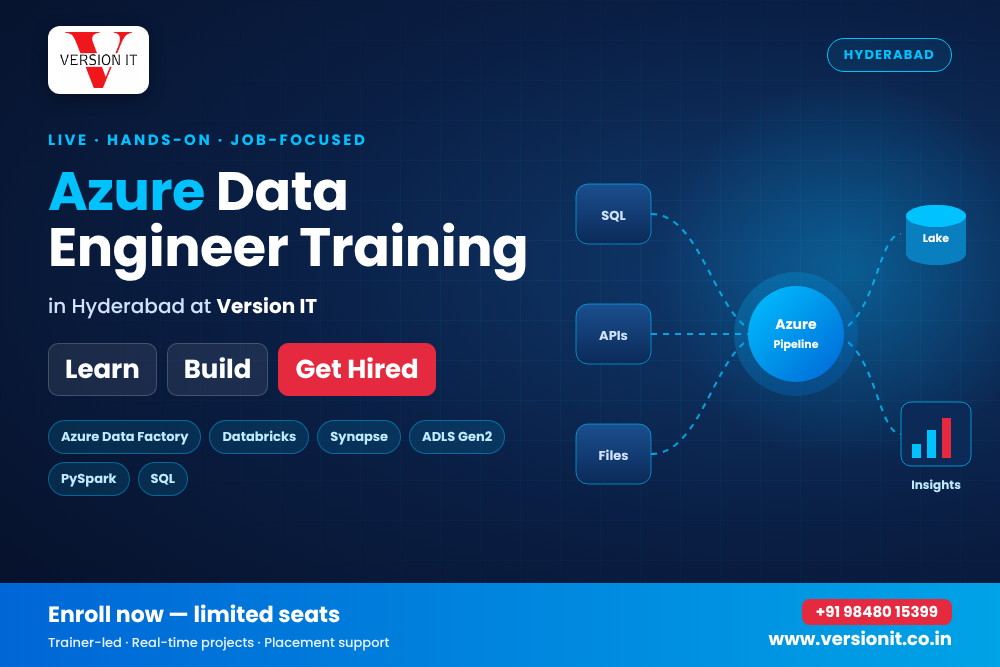
Step into any IT firm in Hyderabad at present and inquire from the hiring manager about his main problem. Most will give you a similar response: there is a lot of data available, but not enough people to handle it. Sales records, app logs, customer clicks, sensor feeds, payment transactions – all are being generated every second. Someone has to gather the data, clean it up, transfer it and make it ready for analysis. That is a job for a data engineer.
If you are thinking about stepping into this field, Azure is a smart place to start. And if you want proper guidance instead of scattered YouTube videos, Azure Data Engineer Training in Hyderabad at Version IT is built for exactly that purpose. In the following paragraphs, we highlight the role of the job, what one will learn and how the training will help turn the learner into a working professional.
What Does an Azure Data Engineer Actually Do?
People have a penchant for mixing up data engineers with either data analysts or data scientists. While all three of these jobs have a few similarities, there are also quite a few differences.
A data scientist creates models to make predictions. On a normal day, an Azure data engineer might:
- Pull data from databases, files, APIs, and streaming sources
- Build pipelines that move this data into a central storage system
- Clean messy records and fix quality problems
- Transform raw data into a shape that business teams can use
- Schedule and monitor jobs so everything runs on time
- Keep costs and security under control
Microsoft Azure gives you a full set of tools for all of this, which is why companies running on Microsoft’s cloud keep looking for people who know it well.
Why Hyderabad Is a Great City for This Career
Hyderabad has grown into one of India’s biggest technology hubs. This is a place for large companies, mid-sized product companies, and a long list of service companies. Most of them have shifted their data processing to the cloud and Azure is one of the popular options, particularly within organisations where they already use Microsoft software.
It doesn’t necessarily have to be one or two large companies that have the job openings for data engineers. They can be found in banking, health care, retail, telecom, insurance, and e-commerce. There’s also a practical advantage in learning in the same city that these companies are recruiting. Classes, questions and discussions in person, and greater opportunities for interviews.
The information covered in the training will be:
A good course doesn’t just give you the names of tools. It is logically structured in such a way that each topic builds on the next. The Azure Data Engineer Course is designed in a logical progression that’s easy for students with no experience of IT as well as those with some IT experience.
Foundations first
Before one starts to use Azure instruments it is important to learn the basics of such aspects as SQL, basics of data, what is being kept in databases, and how one distinguishes between structured and unstructured data. Many students miss this and repent. SQL is in practically every data engineering job interview.
- Azure fundamentals
You will understand the structure of Azure, how resources are created, the storage and networking aspects, security and access control. This will allow you to feel confident in moving about the portal without getting lost.
Azure Data Lake and Blob Storage
Data needs a home. You will be taught how to store large amounts of raw data and processed data, how to sort folders and how to control access.
- Azure Data Factory
At this point in your education, you are engaged in several data engineering projects. You are going to develop pipelines, connect to the sources of different types, utilize activities and triggers, and learn how to copy and transform data in huge amounts at the same time. You are also going to practice on handling failures, as pipelines will fail in the real projects and it is essential to know how to fix them.
Azure Databricks and PySpark
The links between big data and slow tools. Databricks and Spark allow processed huge amounts of data in a short period of time. You will develop skills in PySpark programming, working with DataFrames, and implementing transformations similar to the practices used in professional teams.
- Azure Synapse Analytics
You discover how to ingest and access data in a warehouse configuration to easily utilize it by analysts and reporting applications.
- Streaming data
Not every data comes in slices. Some of it runs in continuously. You’re introduced into how to deal with real time data and how they function.
- Security, monitoring and cost control
The subjects in question are mere topics of classes, yet the employers are quite interested in them. Therefore, it is possible to learn how to protect data, manage your pipelines, and save money on cloud services as well.
Learn by Building, Not Just by Watching
This is the thing most people figure out too late: the tutorial sessions and project building are not the same things at all. It is one thing to watch a tutorial, when everything looks easy and simple, and quite another thing actually to build, as several bugs come up, some concatenations do not work, and nothing seems to be working.
This is why hands-on practice sits at the centre of the training. You work on realistic scenarios, such as:
- Ingesting data from multiple sources into a data lake
- Building an end-to-end pipeline that cleans and transforms the data
- Loading final data into a warehouse for reporting
- Scheduling and monitoring the pipeline like a production job
By the end, you are not just saying “I know Azure Data Factory” in an interview. You can explain a project you built, describe the problems you faced, and tell the interviewer how you solved them. That kind of answer stands out.
Who Can Join This Course?
Don’t have to be the top-notch programmer to get started. The learning suits multiple learning styles:
- Graduates seeking to pursue a career in IT field
- Employees who are looking to advance to a data-centric role in support, testing or development
- SQL Developers and ETL Developers looking to move from on-premise to cloud tools
- People looking for a career change from non-IT field who are willing to give regular efforts to the IT profession.
If you already have some knowledge of SQL or Python, you’ll accelerate your learning curve. It’s a good idea to build the base from the beginning with the early sessions. The key is practice and persistence in trying new things when they fail.
Certification Support
Microsoft certifications will add value to your resume, especially if you are competing for a job with a lot of people. The courses are designed to familiarize you with the exam content and what kinds of questions you will find on the exam. Note that Microsoft updates its certification program on a regular basis so it is good to review the exam code and syllabus on the Microsoft Learn website prior to scheduling an exam. Version IT will recommend the appropriate certification to you based on your goals from your instructor.
Keep in mind that, while certificate can allow you access to many things, it is knowledge and experience that will keep you there. Employers will test if you have understood something correctly, so treat certificate as something that can help you but do not forget to take care of the skill you need to have.
Career Support That Goes Beyond the Classroom
Technology is only one half of the story, the other half is how you present yourself in an interview. Along with technical training, Version IT supports learners with:
- Resume building that highlights projects and tools correctly
- Mock interviews to practise answering technical and HR questions
- Guidance on how to explain your projects clearly
- Tips on LinkedIn profiles and job search strategy
- Interview preparation covering SQL, Azure services, and pipeline scenarios
Little details matter a lot, many skilled people miss their chances due to inability to provide a correct description of their work when under pressure.
Skills You Will Walk Away With
By the time you finish the training, you should be able to:
- Design and build data pipelines using Azure Data Factory
- Store and manage data in Azure Data Lake
- Process large datasets using Databricks and PySpark
- Work with Azure Synapse for warehousing and analytics
- Write solid SQL queries for transformation and analysis
- Monitor, troubleshoot, and optimise your pipelines
- Talk confidently about real projects in interviews
Career Opportunities after Training
Once you have these skills, several job titles open up for you:
- Azure Data Engineer
- Data Engineer
- Cloud Data Engineer
- ETL Developer
- Big Data Engineer
- Data Platform Engineer
The amount of money people make is determined by how much they acquire in a specified job via a certain job portal. However, this doesn’t guarantee the stability of the salary numbers due to the different information provided by various sources. What remains unchanged is the demand for specialists. The rapidly growing number of IT firms places greater demands for people capable of running such processes.
What makes Version IT so special?
Why is it that people choose a training institute named as Version IT when there are various training institutes in the city of Hyderabad?
- Practical teaching: The concepts are explained and immediately applied to the work in the laboratory.
- Genuine experiences: Trainers that have experience in data projects in real companies.
- Project-based learning: Making, taking apart and fixing.
- Questions can be asked – Doubt clearing.
- Career direction: resume and interview assistance and job search.
The goal is simple. The Course should give you the opportunity to do, rather than talk about, the work.
Here are a few tips to help you get the most out of training.
Your own habits is what makes you get so far with your selected institute. Here are some tips that assist:
- Practise daily. 45 minutes of “hands-on” work, is better than 5 hours of “hands-on” work once a week.
- Create a small project of your own. Choose a data set from the public domain, and create your own data pipeline from A to B.
- Learn SQL properly. It will provide you with double the mileage of what you wanted.
- Document your work. Give a note/ project description. This is key for interviews.
- Don’t be afraid of making mistakes. Read the error, find the meaning and repeat. This is the stuff that data engineers do.
Final Thoughts
Data isn’t slowing down, nor is the need for individuals who can manage it. Azure data engineering provides you with a clear, practical and lucrative pathway to the cloud and the data world, and Hyderabad is one of the best places to begin that journey.
The Azure Data Engineer Training offered in Hyderabad at Version IT is well-structured and designed for people who wish to learn productively, create relevant projects and be successful during job interviews. Acquire tools, create data pipelines and get to work immediately.
Ready to begin? Visit https://.versionit.co.in or call on +91 9848015399 and book a free demo for a head start in your data engineering career.
Enquiry Form
Recent Posts
Azure Data Engineer Training in Hyderabad at Version IT: Learn, Build, Get Hired

No. 1 Snowflake Training in Bangalore with SQL, ETL and DBT