
- Home
- How to Build Autonomous AI Agents Step by Step
How to Build Autonomous AI Agents Step by Step
- admin
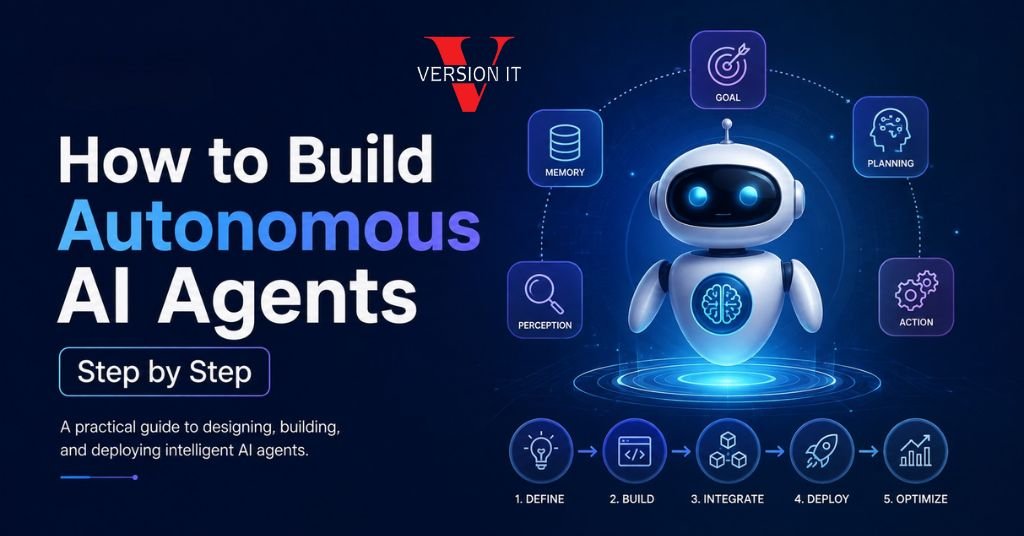
The artificial intelligence is no longer just relying on the machines that provide answers to the questions. The applications of AI today are capable of planning tasks, decision-making, tool usage, information availability, and multi-step workflows with joint human supervision. These systems are more often referred to as autonomous AI agents.
To students and developers, data professionals and working professionals, the knowledge on how autonomous agents operate can offer useful skills on creating the next-generation AI applications. Practical learners who are looking to enroll in a structured learning experience would take Agentic AI Training in Hyderabad to learn about agent architecture, large language models, and tool integration, memory, reasoning, and implementation into the real world.
Constructing a self-sufficing AI agent might seem complicated at first, but it would be simpler with explicit steps. This tutorial details the basic elements and the process involved to create a realistic AI agent.
Establish a Purpose and Roles of Your AI Agent
The initial step of creating an independent AI agent is establishing your desired goals of what the agent can do.
An AI agent is not supposed to be a general system; it has a defined purpose rather than a system lacking specific responsibilities. As an example, you can create an agent that will research a topic, analyze customer questions, plan tasks, produce reports, monitor data, or support software designers.
Prior to writing code, determine the following:
- Which issue will the agent address?
- What will be the inputs it will get?
- What are its decisions?
- What will it require in terms of tools?
- What ought it to do?
- On what occasions must human consent be demanded?
- What in case the agent comes across an error?
Suppose you come up with a research assistant agent. It might be aimed at getting a topic, finding out information available, summarizing the main findings, dividing them into categories, and developing a final report.
Being explicit is crucial in ensuring an agent does not take on unnecessary responsibilities and children developers define the proper boundaries.
Students enrolling in a Hyderabad Agentic AI Course ought to be taught how to map real business needs to frameworks or technologies, by first creating structured agent workflows.
Select the Framework, Tools and LLM
The second one will be selecting the technology stack that will drive the AI agent.
The processor and rationale of most agentic systems is played by large language models or LLMs. They analyze the instructions, produce responses, choose courses of action, and decide what tools are to be employed in one of the workflows.
An AI agent architecture can comprise:
- An extensive language model.
- Python or some other programming language.
- Agent development frameworks.
- external tools/APIs.
- Databases or vectors database.
- Retrieval systems.
- Checking and tracking of components.
Frameworks can make it straightforward to create agents, offering tool calling components, memory, workflows, and multi-agent communication components.
But it is not enough to learn the framework only. The developers ought to be familiar with the concepts of agents concepts such as prompt, tool running, state, context, planning, and error recovery.
An effective Agentic AI Training in Hyderabad program must therefore be more practice oriented on concepts and implementation to ensure that the learners can understand the reason why an agent will act in a given manner.
Include Tools, Memory and Planning Capsabilities
An independent AI agent will prove more helpful when it has the means of communicating with other systems but not just producing text.
Actions are accomplished through tools. An agent can query the database, look up documents, make computations, APIs, search systems, emails, or calendars, or business applications, all of which depend on the application.
Suppose that you are developing a travel-planning agent. It might need tools to obtain the destination information, compare what is possible, compute costs, and produce an itinerary.
Memory is another component that is important. Memory enables an AI agent to store pertinent information between the various steps or interactions.
Examples of common memory are short-term conversational context, user preferences stored, task history, external database records, and documents as retrieved.
Planning is also of significance. Rather than going directly to fulfill a complicated request, an autonomous agent can subdivide the goal into smaller ones.
As an illustration, where the agent gets the order: Prepare a competitor research report, it may:
- Identify competitors.
- Collect relevant information.
- Compare features.
- Analyze positioning.
- Summarize findings.
- Write up a final report.
This is one of the inherent features of agentic AI, as it is possible to formulate and implement various steps.
The students studying Agentic AI Online Training in Hyderabad ought to exercise the skill of developing agents that integrate reasoning, tools and memory and controlled workflow instead of developing chatbots.
Construct the Agent Workflow and establish Safety Controls
After the selection of the core components, the next stage will be to design the workflow.
An agent workflow is a description of the movement the system takes through a process of request to result. A typical workflow could entail the comprehension of the purpose of the user, plan activities, choose tools, perform activities, assess outcomes, and determine the further need of actions.
Action and observational cycle enables the agent to respond accordingly depending on the outcomes. In case a single action fails to get the desired information, the agent is free to attempt an alternative method.
Controls are also required in autonomy. It can pose unnecessary risks by providing an AI system with unlimited access to instruments.
The permissions should be established and limits set on actions like sending messages, altering databases, processing sensitive data, making purchases or destroying material by the developers.
Before high-impact actions can be undertaken, human approval can be included. Logging will also need to be applied in such a way that developers can see what decisions and tools have been made.
Another factor to consider is error handling. The agent must understand what to do in the event of an API failure, information loss, a tool gives unforeseen results or the model is unable to be certain about the next action.
A Hyderabai based Agentic AI On-line course, which involves practical projects, can assist learners in seeing how regulated, observable and dependable workflows can be created as opposed to unregulated autonomy.
Test, Evaluate, and Improve Your Autonomous AI Agent
The creation of the initial iteration of an agent is just the start. The system should be carefully tested in various situations.
Begin with easy requests where the desired outcome is readily verifiable. Then gradually add complexity of tasks, incomplete instructions, tool failures and edge cases.
Evaluate the agent on factors such as:
- Task completion accuracy.
- Quality of decisions.
- Correct tool selection.
- Response relevance.
- Number of unnecessary steps.
- Error handling.
- Execution cost.
- Response time.
- Compliance with safety and permission.
The reasoning workflow at definition level should likewise be inspected at an operational level by viewing tool calls, state transitions, logs and results.
In case a tool is repeatedly selected by an agent, enhance tool descriptions or workflow rules. Should it forget something vital, consider memory management. In case it is taking too many unnecessary steps, enhance planning constraints.
The developers are also expected to test various prompts, model settings, retrieval approaches, and workflow.
Social agent development is not in a vacuum. The best systems have a tendency to develop during repeated testing, evaluation, monitoring and refining.
To allow practitioners to have hands-on exposure to these ideas, Agentic AI Training in Hyderabad offers a systematic learning experience beginning with the basics of LLM, agent designs, tool integration, workflows, memory, RAG, multi-agent systems, applied projects, and deployed concepts.
FAQs
1. What is an autonomous AI agent?
An autonomous AI agent is an AI based system that tries to achieve a goal by making decisions, organizing its tasks, utilizing the tools available to it and reacting on the outcome of its actions. An AI agent, as opposed to a simple chatbot, is able to carry out multi-step workflows, and interact with external systems.
2.Which capabilities are innovations needed to create independent AI agents?
Tools Like Python programming, large language models, prompt engineering, APIs, databases, RAG, tool calling, workflow design, memory management, and basic AI application development are useful. The skills can be developed in a methodical way by enrolling learners in an Agentic AI Course in Hyderabad.
3. Do learning Agentic AI require Python?
Python is quite convenient since most of the AI frameworks, APIs, data-processing libraries, and machine-learning tools can be used with it. New users can also use the basics of Python and then advance to the development of the agent and higher-craft AI algorithms.
4. Will I be able to study Agentic AI online?
Yes. In Hyderabad, Agentic AI Online Training can assist students and working professionals to study online via remote lessons and take on instructor-led sessions, exercises, demonstrations, and projects. Students must prefer courses, which involve both practical agent training and theory.
5. What are the projects I can develop when learning Agentic AI?
The types of research assistants, customer-support agents, document-analysis agents, and coding assistants, sales-support agents, workflow automation system, data-analysis agents, and multi-agent applications can all be built. Going through hands-on projects at an Agentic AI Online Course in Hyderabad may also prove useful in showcasing your application as you ready yourself to work in an AI-related job.
Enquiry Form
Recent Posts

How to Learn Python Full Stack Development Step by Step

How to Start Learning Azure Data Engineer Step by Step

How to Get Your First Workday HCM Job After Training

What Should You Learn Before Starting a Snowflake Career?